
Technical depth
Architecture, data flows and quality criteria are clarified before implementation begins.
Strategy · Development · Integration
We design and build custom AI solutions, integrate them into existing software, develop AI agents and RAG systems, and automate business processes – with pragmatic engineering, clear controls and measurable objectives.

Typical project starting points
The right entry point depends on your current situation. The most common routes are improving an existing process, building a new digital product or adding AI to existing software.

Combine deterministic workflows with AI where text, documents or variable decisions need to be interpreted.
Learn moreBuild new software using real data and explicit quality criteria rather than a superficial proof-of-concept demo.
Learn more
Extend applications, portals and business software without replacing systems that already work well.
Learn moreWhat we build
We do not build AI demos for their own sake. We build systems with a clearly defined role in a real product or business process.
AI software development overviewAgentic workflows and intelligent assistants for clearly defined tasks and business processes.
Learn moreMake company knowledge in documents and data sources usable with language models in a controlled, traceable way.
Learn moreIntegrate GPT, Claude, Gemini or open-source models into software and business processes with the right architecture.
Learn moreAutomate recurring work intelligently without losing control of the wider business process.
Learn moreCustom portals, SaaS products and business applications with AI capabilities that support a real product workflow.
Learn moreValidate new ideas quickly and turn the result into a sound technical foundation for the next stage.
Learn moreOur process
We clarify objectives, users, business processes, data sources and technical constraints.
We define integrations, data flows, security boundaries, quality criteria and sensible limits for AI use.
We build iteratively, integrate real systems and test AI capabilities with representative cases.
We plan deployment, monitoring, cost controls, failure paths and further product development.
Two perspectives – one goal
We build software in which AI can be a core product capability, and we also use AI selectively as an engineering tool.
Architecture, quality control, privacy, security decisions and professional responsibility remain with the development team. AI supports the work; it does not replace accountability for the outcome.
How we use AI in software engineering
Engineering over hype
If a deterministic rule, full-text search or traditional workflow is more reliable, that is often the right solution. AI is useful where variable language, unstructured information or flexible decision-making creates genuine value.
Technologies
We choose models, frameworks and infrastructure based on requirements, not trend cycles or provider branding.
Insights for better decisions
Our technical articles cover recurring questions around RAG, agents, model selection and project cost. They complement the service pages with decision criteria and practical context.
View all insights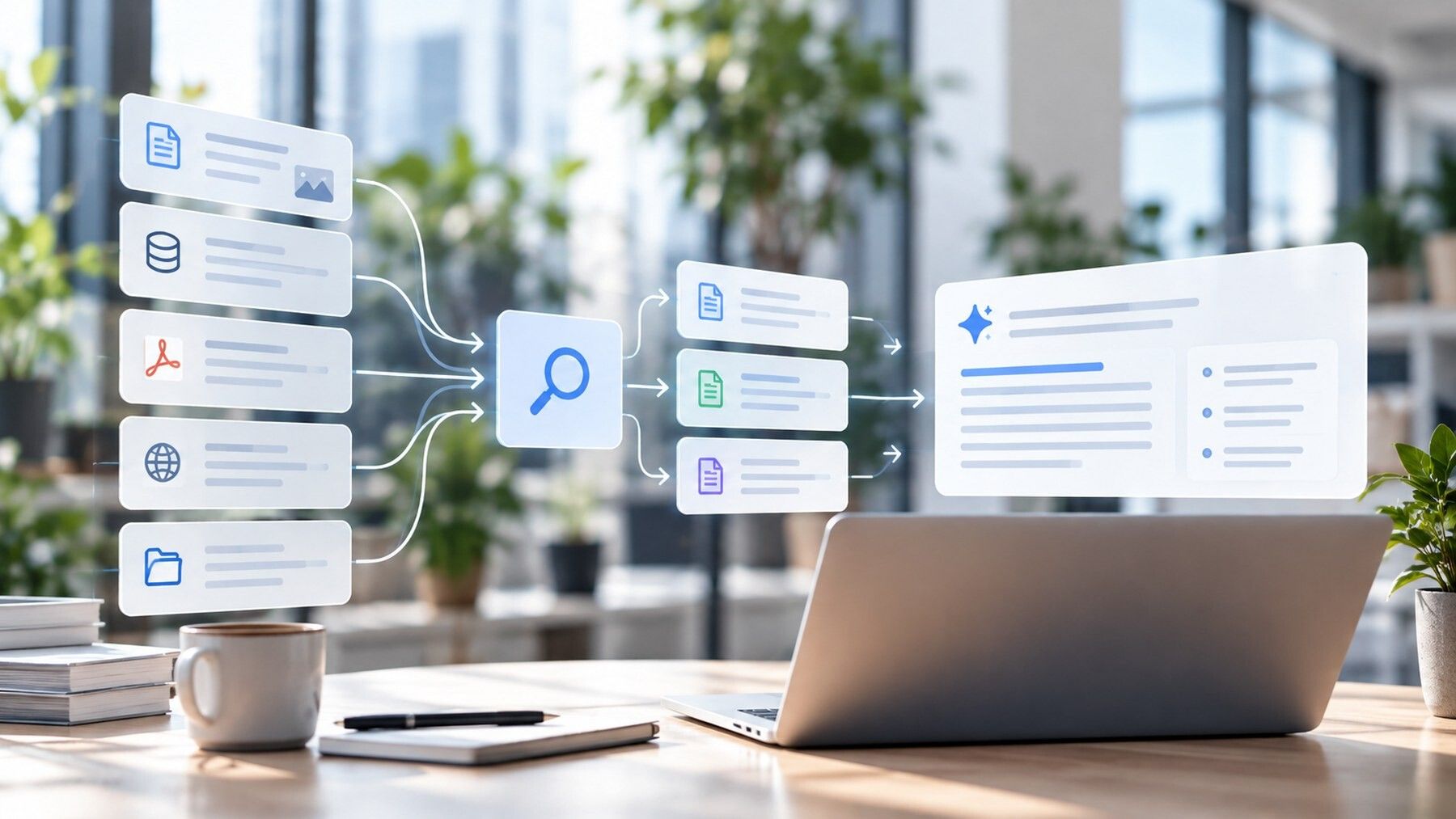
How Retrieval-Augmented Generation connects company knowledge to language models, and when the approach is useful.
Read article
Where agents are useful, where deterministic automation is the better fit and why hybrid systems are often the strongest choice.
Read article
Which criteria matter more than generic model rankings when selecting an LLM for a real software product.
Read articleWhy KI-Softwareentwicklung.de
We treat AI capabilities as part of a complete software system, including data, interfaces, security, quality and operations.
More about our engineering approachArchitecture, data flows and quality criteria are clarified before implementation begins.
New capabilities are planned around existing systems, APIs and responsibilities wherever that is the better solution.
Testing, permissions, validation and human approval are matched to the risk of the use case.
Monitoring, cost controls, failure paths and future model changes are part of the system design.
Frequently asked questions
The key question is not which model currently receives the most attention, but which approach is robust for the actual use case.
Cost depends mainly on product scope, integrations, data quality, quality requirements and the operating model. A short discovery phase is often the most sensible way to define scope and produce a more reliable estimate for the next stage.
RAG is particularly useful when answers need to be based on your own documents or knowledge sources and those sources need to remain current, traceable or permission-aware.
Yes. Extending an existing system is often more sensible than rebuilding it. The key factors are available APIs, data access, security requirements and the existing architecture.
Privacy and information security are assessed for each project. This includes data flows, providers, storage locations, processing agreements, permissions, logging and the question of which data a model should be allowed to access at all.
A focused prototype can be delivered much faster than a production business application. Timelines are driven mainly by integrations, data preparation, quality assurance and business approvals.
In an initial conversation, we clarify the objective, current situation and sensible next steps.
To get started, your objective, existing systems and the main open question are enough.